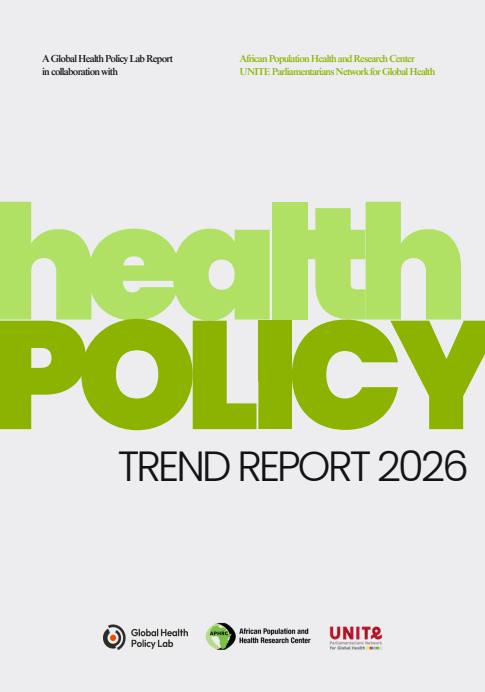
The Global Health Policy Lab (GHPL) has launched the Health Policy Trend Report 2026, developed in partnership with UNITE Parliamentarians Network for Global Health and the African Population and Health Research Center (APHRC). The report brings together a global survey of health policymakers, real-world case studies, and direct contributions from UNITE members, to spotlight the key challenges, emerging opportunities, and actionable solutions shaping the future of health policymaking.
The report was launched at the Berlin University Alliance Grand Challenges Conference, with a keynote from UNITE Member Hon. Sascha van Beek. The launch event was moderated by GHPL’s Executive Director, Branwen J. Hennig, and Policy Analyst & Researcher, Michael Bayerlein.
At a time of rapid global change, collaboration and evidence-based policy have never been more critical. UNITE is proud to have contributed to this resource and to share it with the global health community in support of stronger, more resilient health systems worldwide.
What’s in the Report
Drawing on a global survey of 109 policymakers across 49 countries alongside research evidence and solutions-in-action case studies, the report identifies three recurring challenges facing health policymakers everywhere: short-termism and political pressure, stretched resources and limited access to best practices, and gaps in relevant expertise and evidence use.
To address these, the report lays out a clear roadmap of recommendations:
📚 Short-term: Leverage Technology in the Policymaking Processes
📚 Medium-term: Make Evidence-Use the Default
📚 Long-term: Secure Structural Reform and Overcome Silos
UNITE Members at the Heart of the Report
A defining feature of the Health Policy Trend Report 2026 is its “Solutions in Action” section – real-world case studies contributed directly by parliamentarians, grounding the report’s findings in lived policymaking experience. UNITE members featured in the report include:
- Hon. أميرة صابر Amira Saber — on Egypt’s landmark hepatitis C elimination campaign, achieved through high-level political coordination and a whole-of-government, whole-of-society response.
- Hon. Denis Naughten — on how cross-party, evidence-informed collaboration delivered Ireland’s durable ten-year Sláintecare healthcare reform plan.
- Hon. Dr. Éctor Jaime Ramírez Barba — on Mexico’s Chiapas state model for reducing maternal mortality through culturally-adapted emergency obstetric transport networks.
- Hon. Mariam Jashi — on strengthening evidence use to cut sepsis mortality across Australia, Ireland, and the United Kingdom.
- Hon. Sonia Sidhu — on Canada’s national consensus-building process for responsible AI governance in healthcare.
- Hon. Prof. Dr. Andrew Ullmann — on how Germany’s cross-party Global Health Subcommittee strengthened parliamentary capacity to respond to global health crises like COVID-19.
Together, these case studies demonstrate what’s possible when political leadership, evidence, and sustained institutional commitment align — and offer a practical playbook other policymakers can adapt to their own contexts.
Read the Full Report
🔗 Health Policy Trend Report 2026
Continuing the Conversation at the UNITE Global Summit
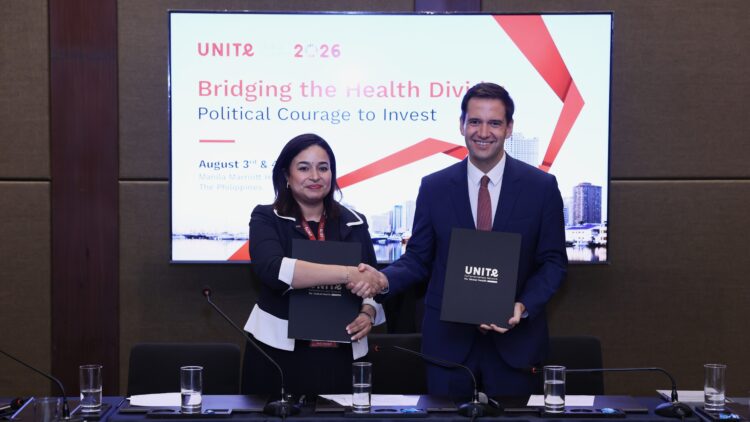
The conversation doesn’t stop here. GHPL will be presenting the report’s findings and recommendations at the UNITE Global Summit 2026, taking place August 3 & 4, 2026, in Manila, The Philippines. They will also be launching the 2027 Policymaker Survey which will feed into the 2027 Health Policy Trend Report.
Join parliamentarians, researchers, and global health leaders as we dig deeper into how these recommendations can be put into action worldwide.